
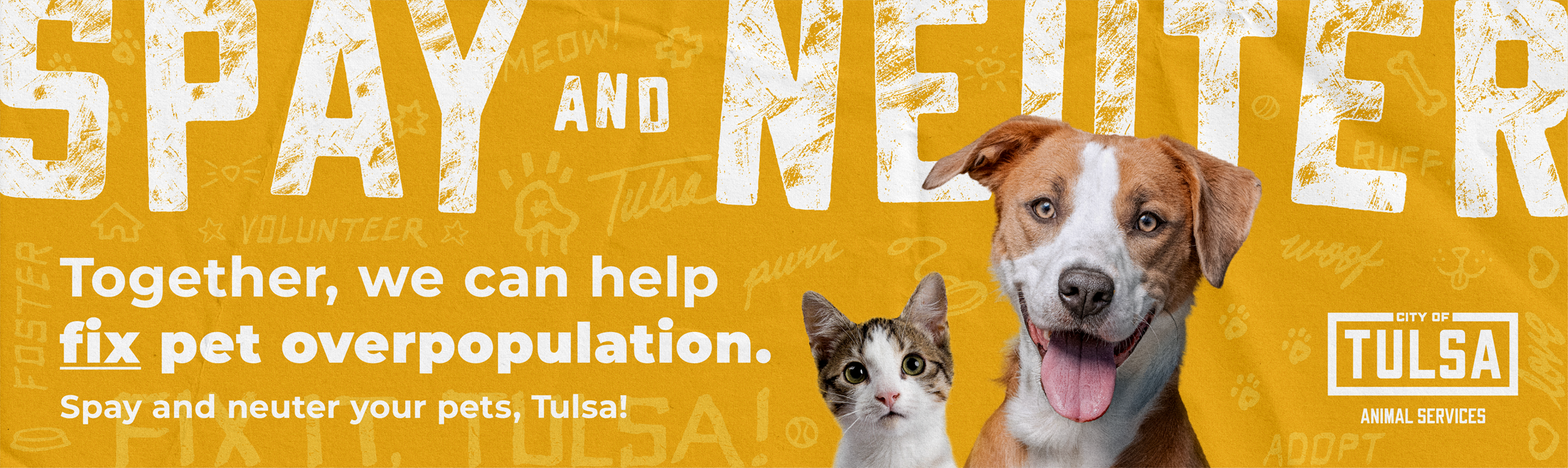
Fix It, Tulsa is a citywide educational campaign to support the reduction of pet overpopulation through public education, prevention and partnerships.
Prevention measures, such as Spay/Neuter interventions, are the single most effective method for controlling pet overpopulation. Because these surgeries provide permanent birth control, they prevent accidental litters - breaking a cycle that can multiply into hundreds of thousands of offspring from just a few unaltered pets over several years.
Partnerships are also important. The City continues to team up with local partner organizations and is calling on all local veterinarians and veterinary clinics to team up with the City to help reduce pet overpopulation in Tulsa.
Need Low- or No-Cost Pet Services?
As part of the City of Tulsa’s Fix It, Tulsa campaign, Tulsa Animal Services is working with local veterinarians and community partners to connect pet owners with available low-no-cost services, including:
If you are interested in being notified when these services become available, please provide details and contact information to the following email: spayandneuter@cityoftulsa.org
**Due to high demand, services will likely not be immediate. Emails will be added to a first-come, first-served notification list, and residents will be contacted as clinics, appointments, and services become available through participating partners.
What We're Doing
In addition to increasing awareness regarding the importance of spay/neuter, Tulsa Animal Services is strengthening partnerships across the Tulsa metro to boost the availability of low-to-no-cost spay/neuter, vaccination, and microchipping services in Tulsa.
Recently, the City held several free clinics:
Upcoming community opportunities and clinics will be communicated on our social media channels.
Tulsa Animal Services has launched the Fix It Challenge, an initiative that encourages local veterinarians and community partners to contribute their time through:
Local organizations and businesses interested in learning more can email Tulsa Animal Services Director Sherri Carrier: sherricarrier@cityoftulsa.org
Spaying and neutering are safe, common procedures that help pets, families and the entire Tulsa community.
When more pets are fixed, fewer unwanted litters are born, fewer animals enter shelters and more resources are available for pets that truly need help.
Health Benefits for Pets
Spaying and neutering can help pets live longer, healthier lives.
Benefits may include:
Talk with your veterinarian about the best timing for your pet based on their age, breed, size and health.
Behavioral Benefits
Spaying and neutering may help reduce behaviors connected to mating instincts.
This can include:
Spaying and neutering will not change your pet’s personality. Your pet will still be the same companion you know and love.
Benefits for Families
Preventing an unplanned litter can save families time, stress and money.
Raising puppies or kittens requires food, supplies, vaccinations, veterinary care and safe placement in responsible homes. Spaying or neutering helps avoid those unexpected costs and responsibilities.
It also helps keep pets safer by reducing the urge to roam, which can lower the risk of getting lost, injured or hit by a car.
Benefits for the Community
Pet overpopulation affects everyone.
When there are more animals than available homes, shelters and rescue groups face increased strain. More animals need housing, food, medical care and placement support.
Spaying and neutering help:
Benefits for Tulsa Animal Services
Tulsa Animal Services works every day to care for animals in need. But shelters cannot adopt, foster or rescue their way out of pet overpopulation alone.
Prevention is one of the most effective long-term solutions.
When more pets are spayed and neutered, TAS can focus more resources on animals who are lost, injured, neglected, abandoned or truly in crisis.
A Simple Choice With a Big Impact
Spaying or neutering one pet can prevent multiple unwanted litters over time.
That one decision helps protect your pet’s health, supports your family and strengthens animal welfare across Tulsa.
Separating Fact from Fiction
There are many misconceptions about spaying and neutering pets. Unfortunately, these myths can prevent pet owners from making informed decisions and contribute to pet overpopulation in our community.
Here are some of the most common myths—and the facts behind them.
Myth: My pet should have one litter before being spayed.
Fact: There is no medical or behavioral benefit to allowing a female pet to have a litter before being spayed.
In fact, veterinarians generally agree that spaying before multiple heat cycles can reduce the risk of certain reproductive diseases and cancers.
Myth: Spaying or neutering will change my pet’s personality.
Fact: Spaying and neutering do not change your pet’s personality, intelligence, affection level or ability to be a loving companion.
Your pet will still be the same pet you know and love. The procedure may reduce behaviors driven by reproductive hormones, such as roaming or marking territory, but it will not change who they are.
Myth: My pet is an indoor pet, so they don’t need to be fixed.
Fact: Even indoor pets can escape through open doors, damaged fences or unexpected accidents.
Spaying and neutering also provide health and behavioral benefits that have nothing to do with whether your pet spends time outdoors.
Myth: Spaying and neutering are dangerous.
Fact: These procedures are among the most common surgeries performed by veterinarians.
While every surgical procedure carries some risk, complications are uncommon when performed by trained veterinary professionals. Most pets recover quickly and return to normal activities within days.
Myth: My pet will become lazy and overweight after surgery.
Fact: Weight gain is typically caused by consuming more calories than are burned through activity.
A healthy diet and regular exercise—not reproductive status—are the primary factors that determine a pet’s weight and fitness.
Myth: It’s cruel to spay or neuter a pet.
Fact: Spaying and neutering can actually improve a pet’s quality of life.
The procedures help prevent certain diseases, reduce the risk of reproductive cancers and eliminate the physical stress associated with repeated pregnancies and heat cycles.
Myth: Male pets don’t contribute to pet overpopulation.
Fact: Every litter has both a mother and a father.
Neutering male pets is just as important as spaying female pets. Intact male animals are more likely to roam in search of mates, which can increase the likelihood of accidental breeding and injuries.
Myth: My pet is too old to be spayed or neutered.
Fact: Many adult and senior pets can still be safely sterilized.
Your veterinarian can evaluate your pet’s health and determine whether the procedure is appropriate. Age alone does not automatically prevent a pet from being fixed.
Myth: Spaying and neutering only benefit shelters.
Fact: Spaying and neutering benefit pets, owners and the entire community.
Benefits include:
Myth: I can always find homes for the puppies or kittens.
Fact: Many pet owners believe this, but the reality is that animal shelters and rescue organizations across the country continue to receive more animals than there are available homes.
Even well-intentioned litters can contribute to overcrowding and make it more difficult for existing shelter pets to find families.
Myth: Spaying and neutering are too expensive.
Fact: The cost of an unexpected litter is often much higher than the cost of prevention.
Food, vaccinations, veterinary care and ongoing pet expenses can add up quickly. Many communities also offer low-cost clinics, vouchers and financial assistance programs to help pet owners access services.
Myth: My pet doesn’t need to be fixed because they’re never around other animals.
Fact: Accidents happen.
A gate gets left open. A door doesn’t latch. A pet slips away during a walk.
Many unplanned litters result from situations pet owners never expected. Spaying and neutering help eliminate that risk.
Myth: Pet overpopulation isn’t a problem in Tulsa.
Fact: Animal shelters nationwide, including Tulsa Animal Services, continue to face challenges related to pet overpopulation, particularly during peak breeding seasons.
Spaying and neutering remain one of the most effective long-term strategies for reducing shelter intake and improving outcomes for animals in our community.
Myth: Someone else will fix the problem.
Fact: Addressing pet overpopulation requires community participation.
Veterinarians, shelters, rescue organizations, local governments and pet owners all play a role. Every pet that is spayed or neutered helps reduce future shelter intake and supports a healthier community for animals and people.
.png)


 Facebook
 Twitter
 Mail
Mail