

Instructions are provided below for using the T-Town HOME Catalog. Please contact us if you have any questions.
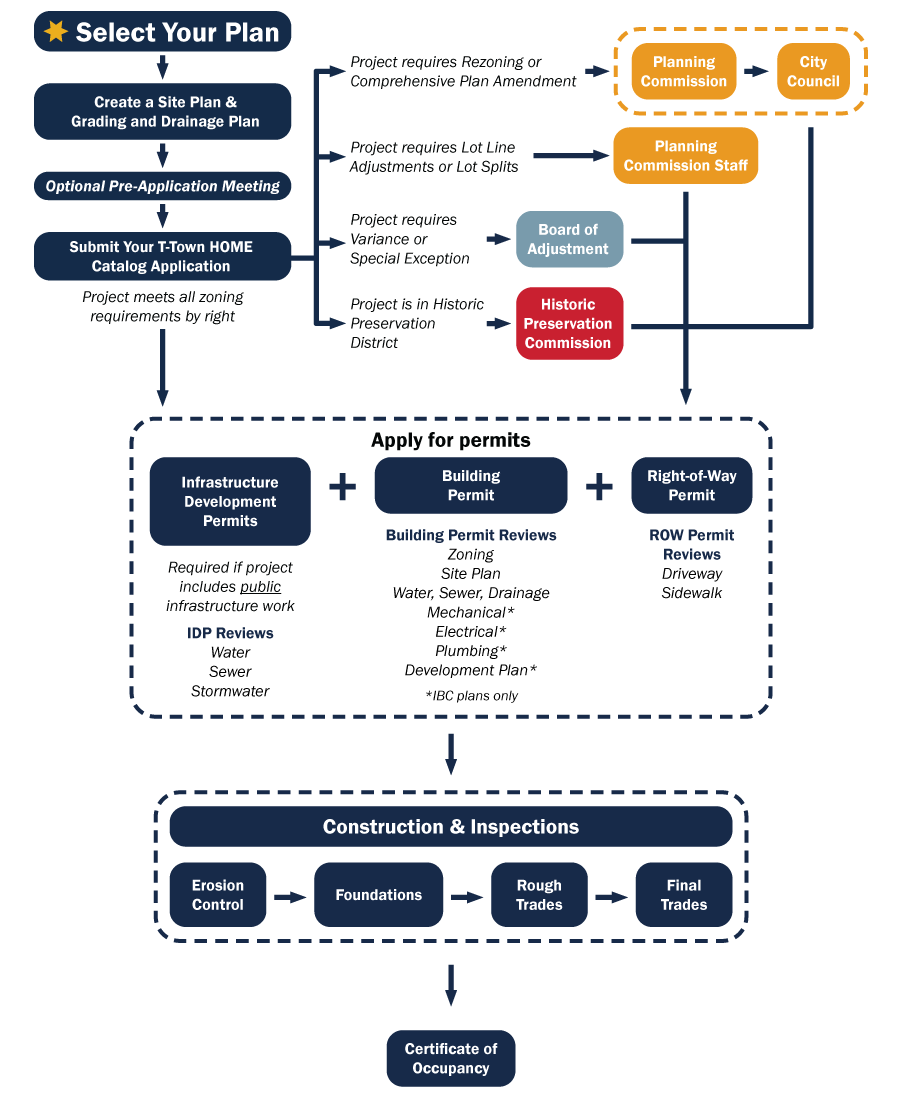
Building Site Layout
Select a Plan: Select a building plan from the T‑Town HOME Catalog. Ensure that you have a valid address for your project. For address changes, send an email to addresschange@cityoftulsa.org.
Verify Zoning: Confirm that the selected building type is allowed in the applicable zoning district and that it can fit on your property, accounting for all required setbacks.
Find your property’s zoning at maps.cityoftulsa.org/tulsazoning. Learn what is allowed in each zoning district in the zoning code at tulsaplanning.org/resources/plans.
Create a Site Plan & Grading and Drainage Plan: Visit maps.cityoftulsa.org/lotviewer to download maps of your lot that include city infrastructure and other required information. You may use those maps in developing your site plan and grading and drainage plan, showing the location and orientation of your buildings. Review the Site Planning 101 section in the catalog for design principles and the site plan checklist.
Submit Your Application: Send your completed T-Town HOME Catalog application (available at cityoftulsa.org/homecatalog) to catalog@cityoftulsa.org. Schedule a pre-application meeting, if desired. After your application review is complete, you will then receive your building permit plan sets.
Design Development
Variations: Review the list of allowable variations in the catalog and on the building permit plan sets, and select your preferred variations, if any, on the permit set. If any proposed changes are not listed, you may request customizations to the plan from the plan designers.
Contact: Identify your General Contractor and any sub‑contractors (electrician, plumber, and HVAC) who will be involved in completing your project. Make sure they are familiar with the requirements of the program as well as your design selections.
Other Approvals: Secure the other required approvals, which may include those from the Planning Commission, Board of Adjustment, City Council, and Preservation Commission.
Submittal
Apply for Permits: Submit your building permit application, including your site plan, grading and drainage plan, right-of-way permit application, and pay all applicable fees online at cityoftulsa.org/permitting (your general contractor might complete this step.) If your project includes extending, replacing, or relocating water, sewer, or stormwater mains, you may need to apply for an Infrastructure Development Permit (IDP.)
Review: Development Services will review your application, and may request further information or modifications pertaining to your application or site plan or grading and drainage plan before issuing your building permit. This review could take up to five days.
Inspections: Inspections will occur after construction begins. All inspections must be passed before you are issued a Certificate of Occupancy.
Infrastructure Development Permit
If your project includes extending, replacing, or relocating public infrastructure, you may be required to apply for an Infrastructure Development Permit (IDP.) Infrastructure work must be completed before permits are issued.
Building Permit
You can apply for your building permit after obtaining any necessary approvals from Planning Commission, Board of Adjustment, the Preservation Commission, and City Council.
Apply for your permit through the Permit Center. Note that the application fee must be paid for reviews to start. Applications can be submitted online or in person; online applications will be put in the queue to be processed by permit specialists, while in‑person applications will be processed by the permit specialist during your visit. After being processed by the permit center, the project is considered “Submitted” in the system and reviewers will be assigned to projects from the queue.
If the application passes all reviews, the permit will be issued. If the application fails one or more reviews, a Plan Corrections Summary will be issued, and a resubmittal will be required.
Right-of-Way Permits
Constructing driveways, curbs, and sidewalks requires a right-of-way permit. Start this process as soon as you are able, as this permit is required before a Certificate of Occupancy can be issued. There are two types of right‑of‑way permits:
Construction
Following the required approvals, construction can begin. Inspections will be required throughout construction as work is completed.
The first inspection that will take place is the Erosion Control Inspection. Once foundation work and foundation utility work (rough–in mechanical, electrical, and plumbing) is complete, schedule rough trade inspections and a building foundation inspection.
Once framing and utilities are in place, schedule final trade inspections and a final building inspection. See the inspection services webpage on the City of Tulsa website for more information.
Certificate of Occupancy
After construction is complete and all required approvals have been obtained, apply for a Certificate of Occupancy. See the Permit Center webpage for more information.
T-Town Lot Viewer Advice
Here are some helpful tips in creating this plan using the T-Town Lot Viewer: Find your project property in the map and zoom so you can see one full lot beyond yours on all sides. Export this to a PDF and print it. Draw in your building footprint, distance from lot lines, and add arrows indicating the current and future water flows.
Planning Commission
Projects requiring rezoning, comprehensive plan amendments and subdivisions will need approval from the Planning Commission.
When submitting your application, ensure that you follow the specific requirements and meet the application deadlines. Projects requiring rezoning and comprehensive plan amendments will also require City Council approval. City Council will discuss the item at a committee meeting prior to official action: a “first reading” and then a “second reading” with a vote.
After approval, it will be added to the mayor’s signing agenda. It will take effect 30 days after publication in the newspaper. The entire process takes a minimum of 120 days, and we recommend starting as early as you are able to. Visit the Planning Commission website for more information.
Board of Adjustment
Your project may require special exceptions and/or variances from the Board of Adjustment. When submitting your application, ensure that you follow the specific requirements and meet application deadlines.
The Board will consider the item and following approval, you will be able to apply for a building permit. This process takes a minimum of around 40 days, and we recommend starting as early as you are able to. Visit the BOA website for more information.
Historic Preservation
Projects (including exterior alterations or repair, new construction, and demolition) within a historic preservation-zoned district must be approved by the Tulsa Preservation Commission or its staff. Refer to the city’s zoning map to confirm if your project is located in an HP overlay district. Review the design guidelines for your project’s neighborhood; variations to the plans are allowed (see the Allowable Variations), but the Preservation Commission may prohibit certain modifications.
An HP permit is required before a building permit application can be submitted. To obtain an HP permit, you must first apply for a permit with supporting plans, photographs, and brochures. The typical review process is administered through public meetings. Decisions may be appealed to the Board of Adjustment. See the TPC website for more detailed information on the review process.
T‑Town HOME Catalog units were reviewed by the Tulsa Preservation Commission to help ensure future approvals for program users, but an official historic preservation permits are still required if your project falls within a historic preservation-zoned district.
For additional information or to contact Tulsa Preservation Commission staff, visit tulsapreservationcommission.org.
The construction of pre‑approved buildings is required to match the construction drawings, details, specifications, and program guide requirements to the greatest extent possible; however, some minor variations are acceptable. How much can you vary a T-Town HOME Catalog plan and still have city pre‑approval apply?
A reasonable amount of variation is allowable, especially non‑structural and interior minor changes that won’t have code implications. These variations may be administratively approved if noted on the permit drawings in red for clear building permit review. Some other allowable variations are always allowed, as outlined below.
We recommend that homeowners and builders check with the Permit Center before making any changes to the pre‑approved plans. Also note that the non‑exclusive license to build a pre‑approved plan provides no liability protections if a homeowner or builder makes changes to the plan that cause the building to be out of compliance with code.
Mirrored Plans
Exterior Materials
Siding, eaves, and exterior trim options are limited to those available for selection on each plan’s pre‑defined checklist of options. Indicate intended selections on building permit set.
Porch railings and post designs are encouraged to be varied for architectural variety, as long as the proposed design meets code requirements.
Porch railings may be removed if compliant with building code (generally under a 30” drop).
Confirm material limitations with underlying historic district requirements if your lot falls within a historic preservation overlay district.
Roof
Ceiling Heights
Windows + Doors
Porches
Foundation + Walls
Foundation details will require an engineer’s design and stamp in the following non‑typical conditions:
All information on the checklist should be provided on a site plan with your building permit application. The City of Tulsa created the T-Town Lot Viewer, an interactive site plan tool, to help applicants with this process. Visit the Online Map Viewer.
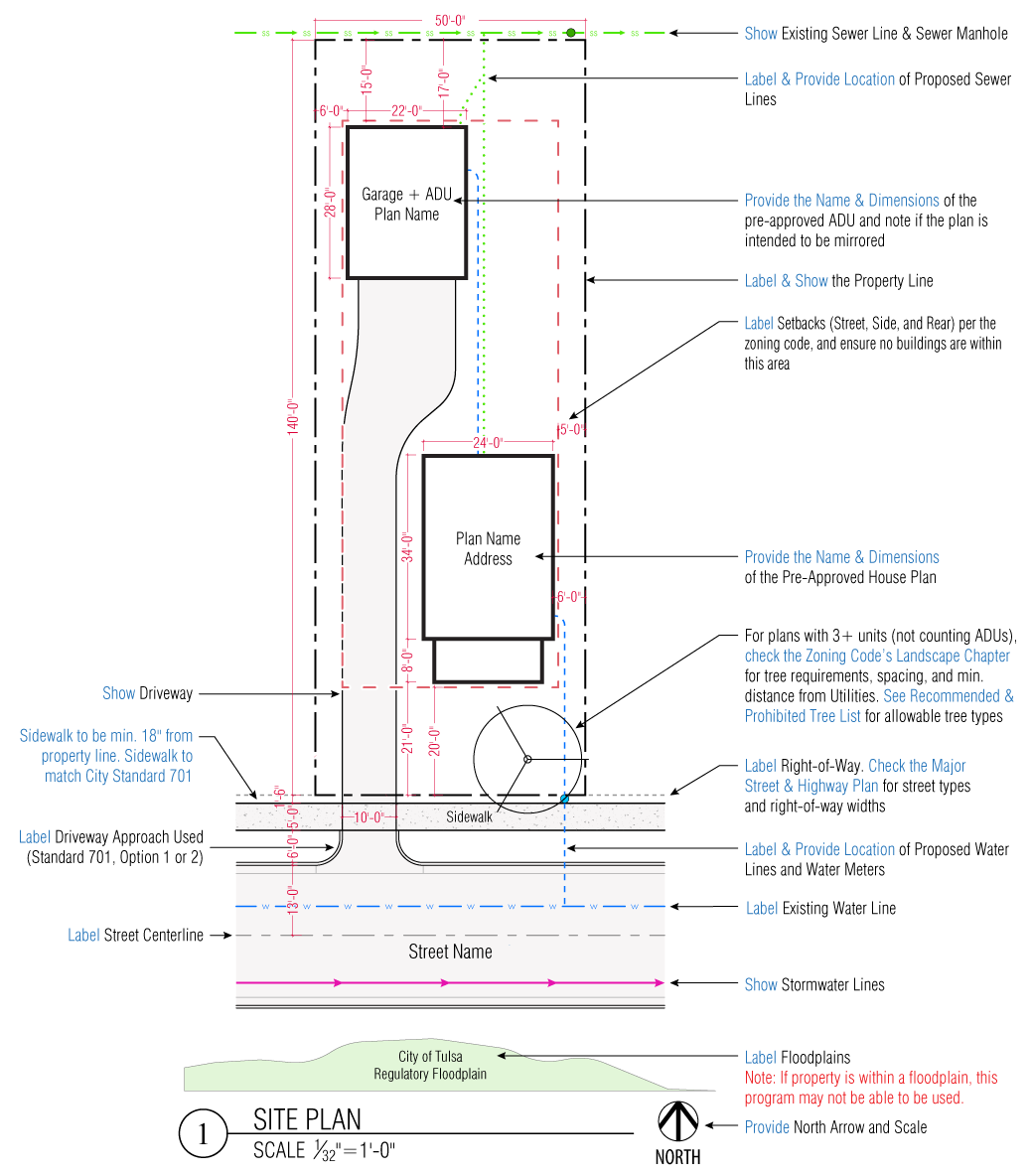
Requirements
Every T‑Town HOME Catalog building permit application requires a site plan. While the catalog provides pre‑approved building designs, each lot in Tulsa has unique conditions—utilities, grading, drainage patterns, and neighboring structures—that must be considered before construction.
A site plan ensures that your chosen Catalog building type is accurately placed on your lot and that it functions as intended. Additional guidance is provided in this checklist to ensure that adequate information is provided for your awareness, your contractor’s awareness, and so reviewers have enough information to approve a project quickly.
Missing, incorrect, or unclear information may require revisions to your site plan, extending your time in permit review.
The site plan is critical not only for quick permit reviews but also to ensure that your builder and subcontractors on site have coordinated and accurate information about the infrastructure and layout of the site. Many of the recommended site plan arrangements at the end of the catalog have little extraneous space, making coordination and accurate layouts key to success.
Utility connections and service lines should be carefully planned and coordinated for on-site installation, including ensuring the latest equipment sizes and required service easements are provided to meet both city (water, sewer, refuse) and franchise utility (cable, gas, electric, high-speed internet, etc.) requirements.
For IBC plans, fire access requirements should be clearly diagrammed to ensure that the fire department can access the buildings in an emergency. A clear 20’ street width should be maintained in front of the building to provide a compliant fire access route, and all parts of the building should be within a 150’ distance from this fire access route.
Checklist
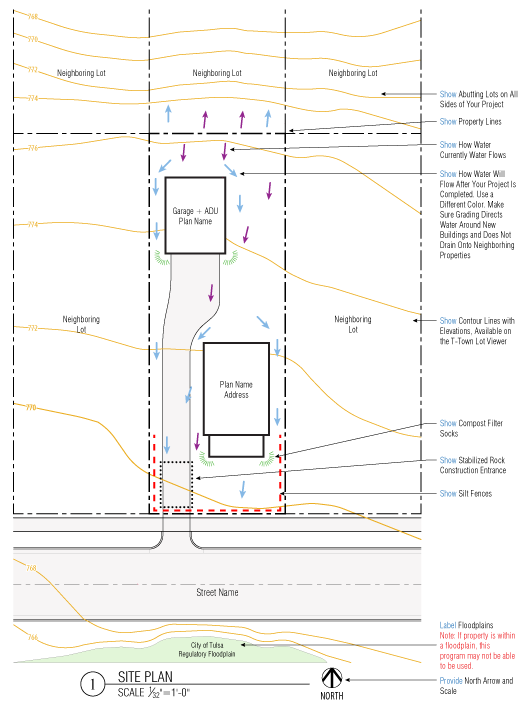
Example Grading & Drainage Plan
All information on the checklist should be provided on a grading and drainage plan with your building permit application. The City of Tulsa created the T-Town Lot Viewer, an interactive site plan tool, to help applicants with this process. Visit the online T-Town Lot Viewer to get started.
Requirements
In many cases, infill development in Tulsa has resulted in lots being filled or graded in ways that significantly change stormwater flows, without consideration of the effects of such changes on neighboring properties. This can result in flooding and damage to existing properties.
In order to provide more efficient permit review and approvals, and to limit stormwater runoff issues with neighbors, users of T‑Town HOME Catalog Plans are asked to provide a bit more information pertaining to grading and drainage for your lot and the surrounding lots, in order to provide appropriate context for reviewers to understand the existing and proposed site conditions.
Provide a detailed grading and drainage plan at the same scale as your site plan (with the required information found in the checklist to the right), which may be provided via the Online T-Town Lot Viewer.
The plans should clearly convey to a reviewer the context of current and proposed grading and storm flows across the site, especially on sites with steep slopes.
Water flows should generally remain the same pre‑ and post‑development.
In some cases, development may have an opportunity to improve existing storm flow conditions by re‑routing stormwater in a more advantageous way. Such changes are encouraged to be clearly described for site plan review approval.
For sites with particularly challenging stormwater flow conditions, a more detailed Drainage and Detention Report may be required, in accordance with Section 503 of the Stormwater Management Criteria Manual. Visit Infrastructure Development, click the Infrastructure Development Process (IDP) dropdown, and then click on the link to the Stormwater Management Criteria Manual.
Checklist
Projects requiring a right-of-way permit can utilize the site plan from the T-Town Lot Viewer for the application, with the addition of the following information:
Traffic Control Plan: For driveways that are on or adjacent to an arterial street, the City of Tulsa will require a traffic control plan. Traffic control plan may be obtained from several companies including Action Safety Supply, Advanced Workzone Services, Direct Traffic Control, RoadSafe Traffic Systems, and Area Wide Protective.
For driveways on residential streets, the City of Tulsa does not require a traffic control plan.
Driveways being installed on an arterial street, or for dwellings bigger than duplexes will require an Access Review from traffic engineering. The contractor doing the work will need to be either IDP approved for transportation or Pre‑qualified with an A or C certification.
Sidewalk Requirements: Sidewalks are required on all arterial roads and new residential homes that abut curbed streets. If you do not want to build sidewalk, you can request to pay a fee in lieu of by emailing sidewalk‑fee@cityoftulsa.org. The sidewalk will need to be built, or the fee will need to be paid before the final right-of-way inspection can occur. Not doing either will hinder the ability to obtain a certificate of occupancy.
Bonding Requirements: Each driveway for single family residential homes or duplexes built in the City of Tulsa will require a driveway bond in the amount of $5,000.00. You will need to provide the original copy of the bond along with the power of attorney page your insurance provider gives you, either by mail or by bringing it to the 4th floor of City Hall. All bonds will be reviewed by the City’s legal department and are subject to approval. For dwellings larger than duplexes, if the permit involves arterial streets, the amount of the bond shall be $250,000; if the permit is for non‑arterial streets, the amount shall be $100,000.
.png)


