
“Every kid in our community deserves a chance at a bright future and I’m happy to formally commit ourselves to this work by institutionalizing a dedicated office for children, youth, and families here at City Hall,” Mayor Nichols said. “By prioritizing this work, we are setting a bold direction for our city and I’m eager to see the opportunities this will bring to so many in Tulsa.”
- Mayor Monroe Nichols IV
MOCYF is responsible for implementing a strategic plan to ensure that an additional 15,000 Tulsa children and youth are on a path to economic mobility and thriving by 2030.
MOCYF has contracted with local cradle to career nonprofit organization, ImpactTulsa operate the office and staff the Tulsa Children’s Cabinet. The Office will serve as a collaborative hub for improving outcomes for Tulsa’s children and families by aligning cross-sector efforts, leveraging data-driven solutions, and mobilizing community resources.
In its first year, the Mayor’s Office of Children, Youth, and Families focused on building the civic infrastructure needed to improve child and youth outcomes. This included establishing the Children’s Cabinet, launching the Action Alliances, and beginning to normalize a whole‑of‑city approach to supporting student success. Learn More....
In its second year, MOCYF will strengthen the Tulsa Children’s Cabinet’s governance, secure funding for and launch Action Alliance‑led pilots, and continue advancing policy, program, and practice changes that drive sustained improvements in student outcomes.
Additional resources for data on Tulsa’s Children and Youth:
The Tulsa Children’s Cabinet, established in May 2025, brings cross‑sector leaders together to improve outcomes for Tulsa’s children. Currently about 100,000 Tulsa children and youth are meeting certain milestones identified as stepping- stones to economic mobility. We need an additional 15,000 more to be on this path.
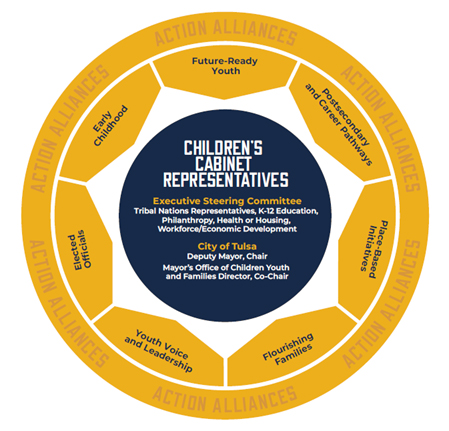
United around this goal, the Tulsa Children’s Cabinet includes representatives from the systems and institutions shaping children’s environments and opportunities. It also convenes Action Alliances—groups of individuals, organizations, and educational institutions that directly serve children, youth, and families.
The Action Alliances provide the Children’s Cabinet critical insight into the barriers to economic mobility facing children and youth, as well as potential solutions to system and policy challenges. Many Alliance members already participate in citywide initiatives, working groups, and cross‑disciplinary teams focused on the same issues the Cabinet aims to address. Action Alliances ensure on‑the‑ground experience directly informs decisions that system leaders are uniquely positioned to make, such as resource allocation, policy changes, and investment priorities.
In February of 2026 the Tulsa Children’s Cabinet voted to focus on four priority areas that have an impact on the economic mobility of Tulsa’s children and youth:
Anna America | City of Tulsa - Department of Parks and Recreation | Proxy - Hunter Michelsen
Alison Anthony | Tulsa Area United Way
Susana Argueta-Acosta | Student, Union Public Schools
Dr. Maritza Cartagena | Tulsa Area Hispanic Chamber of Commerce
Michael Branan | Green Country Workforce | Proxy - Larod Snyder
Marcia Bruno Todd | Leadership Tulsa; Tulsa Youth Council
Stacey Butterfield | Jenks Public Schools
Leslie Cardiel | Student, Union Public Schools
Nancy Curry | Anne and Henry Zarrow Foundation
Aaron Darden | Tulsa Housing Authority
Bruce Dart | Tulsa Health Department
Jackie DuPont | Coretz Family Foundation
Angela Durant-Tyson | Tulsa Tech
Jamaal Dyer | Friendship Baptist Church
John Federline | Union Public Schools
Lillian Geld | Student, Booker T. Washington
Karen Gilbert | Tulsa City Council
Elizabeth Hall | Burnstein Family Foundation
Keith Hall | Tulsa County Juvenile Bureau
Vanessa Hall Harper | Tulsa City Council
Dion'trae Hayes | City of Tulsa - Department of Resilience and Equity
Chief David Hill | Muskogee Nation | Proxy - Carmin Tecumseh-Williams
Chief Chuck Hoskin, Jr. | Cherokee Nation | Proxies - Kim Teehee & Weston Cox
Ebony Johnson | Tulsa Public Schools
Bill Knight | Tulsa Regional Chamber
Laura Latta | Tulsa Higher Education Consortium
Scott Marr | Tulsa Transit
Jabraan Pasha | Office of Health and Well-being | Proxy - Amy McGehee
Ashley Philippsen | City of Tulsa - Mayor's Office of Children Youth and Families
Krystal Reyes | City of Tulsa - Mayor’s Office
Laurel Roberts | City of Tulsa - Commissioner of Public Safety in the Mayor’s Office
Chief Joe Tillman | Osage Nation | Proxy - Teresa Bledsoe
Elsie Urueta | Tulsa Charter Schools - Tulsa Honor Academy
Annie Van Hanken | George Kaiser Family Foundation (GKFF) | Proxy: Cynthia Jasso
Drew France | Human Rights Commission
Rose Washington-Jones | Tulsa Economic Development Corporation (TEDC) | Proxy - Dr. Joyce McClellan
Dr. Jahaziel Hiriart | Schusterman Family Foundation
For more information or to learn how to get involved please email the Mayor's Office of Children, Youth, and Families.
The Action Alliances provide the Children’s Cabinet critical insight into the barriers to economic mobility facing children and youth, as well as potential solutions to system and policy challenges. Many Alliance members already participate in citywide initiatives, working groups, and cross‑disciplinary teams focused on the same issues the Cabinet aims to address. Action Alliances ensure on‑the‑ground experience directly informs decisions that system leaders are uniquely positioned to make, such as resource allocation, policy changes, and investment priorities.
In this meeting, the Tulsa Children’s Cabinet reviewed and approved its 2026 Charter and Bylaws and discussed recommendations from the Executive Committee regarding the Cabinet’s priority areas for the year. The discussion focused on how the Cabinet can use its role as a group of systems leaders and cross-sector partners to address challenges affecting children, youth, and families across Tulsa.
Members discussed proposed priority areas, including transportation, housing stability, legislative advocacy, third-grade literacy, and broader child and family needs. Transportation and housing stability were identified as root causes connected to chronic absenteeism, while legislative advocacy was discussed as an important opportunity for the Cabinet to assess how proposed policies may impact children from a multifaceted lens.
The Cabinet members also discussed the need for greater clarity around its role, including how priorities would translate into action and how Action Alliances could help provide subject-matter expertise and support implementation. Members raised emerging issues such as belonging, hunger, health, and affordability, while also noting the importance of keeping priorities focused enough to be effective.
The meeting concluded with the Cabinet voting to adopt the four priority areas of transportation, housing stability, early grade literacy, and youth workforce opportunities. The cabinet also voted to focus on legislative advocacy as an area for the cabinet to continue building.
In this meeting, the Tulsa Children’s Cabinet discussed early grade literacy, with a focus on the potential local impact of pending state literacy legislation. The meeting opened with introductions, approval of the February meeting minutes, and legislative updates, including state budget items related to teacher pay, reading and math programs, school vouchers, and the Dolly Parton Imagination Library.
The Cabinet’s main discussion centered on how Tulsa can improve literacy outcomes while preparing for a possible increase in students retained in third grade under new legislation. Members reviewed information from the Early Grade Literacy Action Alliance report, including the finding that only 25% of Tulsa County third-grade students are reading on grade level.
Cabinet members discussed systemic barriers contributing to literacy challenges, including uneven access to high-quality learning opportunities, inconsistent literacy instruction, and delayed identification of students needing support.
Small group discussions identified several areas for Cabinet action, including family engagement, early identification of developmental needs, instructional alignment, teacher retention and support, and access to early learning. Potential actions discussed included a citywide literacy campaign from birth, connecting families to trusted messengers and primary care providers, increasing Pre-K enrollment, supporting science-of-reading instruction outside schools, and engaging retired teachers in small-group tutoring.
The meeting concluded with a next steps to schedule a virtual special Cabinet meeting to discuss the Housing Stability priority as time did not allow the Cabinet to get to that item.
In this special meeting, the Tulsa Children’s Cabinet focused on housing stability as a priority area connected to student success. Deputy Mayor Krystal Reyes opened the meeting by framing the role of the Children’s Cabinet and Action Alliances, encouraging members to consider both their individual roles and the Cabinet’s broader systems-level responsibility in identifying solutions.
The meeting included City updates related to the FY27 budget request to continue funding for MOCYF, the City joining the national Mayor’s Alliance to End Child Hunger, and outreach efforts promoting Pre-K enrollment through the city’s water bill inserts.
Aubrey Flowers provided an overview of the Housing Action Alliance Report, highlighting housing instability as a persistent barrier to student success in Tulsa. The discussion emphasized that housing challenges are closely connected to transportation, safety, access to supports, chronic absenteeism, academic setbacks, and long-term disengagement.
Cabinet members participated in breakout discussions focused on high-leverage opportunities, potential actions, and partners needed. Themes from the large group discussion included stronger connections to policy, coordinated advocacy, better use of existing data, scaling effective models, and transportation solutions such as walking audits, school buses, public transit, rideshares, and carpooling.
The meeting concluded with next steps to explore the City’s utility billing process, identify partners experienced in walking audits, and continue advancing policy and communications efforts.
In this optional meeting, the Tulsa Children’s Cabinet revisited early grade literacy and housing stability to clarify key themes and discuss ongoing community efforts. Members of the Children’s Cabinet shared updates on their current work and reflected on how existing programs and partnerships could be better aligned to support children, families, and students.
The literacy discussion focused on implementing the Strong Readers Act and ensuring that schools and educators have the resources and capacity to carry out reforms successfully. Cabinet members also expressed broad support for the intent of literacy reforms while raising concerns about practical implementation. Teacher support emerged as a critical leverage point, including the need to recruit, train, certify, and retain qualified teachers. Members also discussed paid teacher residency and apprenticeship models as a way to reduce barriers to entering the teaching profession.
The housing discussion highlighted eviction prevention, student housing insecurity, and the need for more proactive upstream solutions. Members discussed school-based supports, eviction notifications, landlord engagement, rent and utility assistance, affordable housing, wage growth, and housing navigation for postsecondary students.
Cabinet members also emphasized the importance of building on existing two-generation and place-based initiatives rather than creating entirely new programs. The meeting closed with a reminder that the next regular meeting would focus on the remaining two priorities of transportation and youth workforce development.
Meeting Agenda
In this meeting, the Tulsa Children’s Cabinet continued its discussion of priority areas by focusing on youth transportation and youth workforce opportunities. Members reviewed and approved previous meeting minutes from April 2, April 30, and May 14, before hearing presentations connected to two of the Cabinet’s adopted areas of focus.
Scott Marr and Naaja Jefferies presented on MetroLink’s services and discussed the increase in youth ridership since free fares for riders under 18 were introduced approximately three years ago. Cabinet members then participated in small group discussions focused on transportation barriers affecting students, including access to schools, internships, and other youth opportunities.
Stacy Boone, FUSE Executive Fellow, also presented on her youth workforce ecosystem project, which examines Tulsa’s landscape of programs, services, and supports for young people seeking career learning, internship, and credential opportunities. Cabinet members discussed how Tulsa can better coordinate opportunities, address barriers such as transportation, and connect youth to meaningful workforce pathways.
The meeting concluded with next steps to synthesize ideas discussed across recent meetings and identify a focused set of potential pilot programs that could be tested this year. These ideas will be presented to the Executive Committee in July and brought back to the full Cabinet in August.
.png)


 Facebook
 Twitter
 Mail
Mail